
Why Real-Time Industrial Monitoring Matters
How immediate visibility helps teams reduce response time, eliminate unrecorded micro-stoppages, and keep modern factory lines moving.
Amine Ben Salem
Industrial Automation Lead
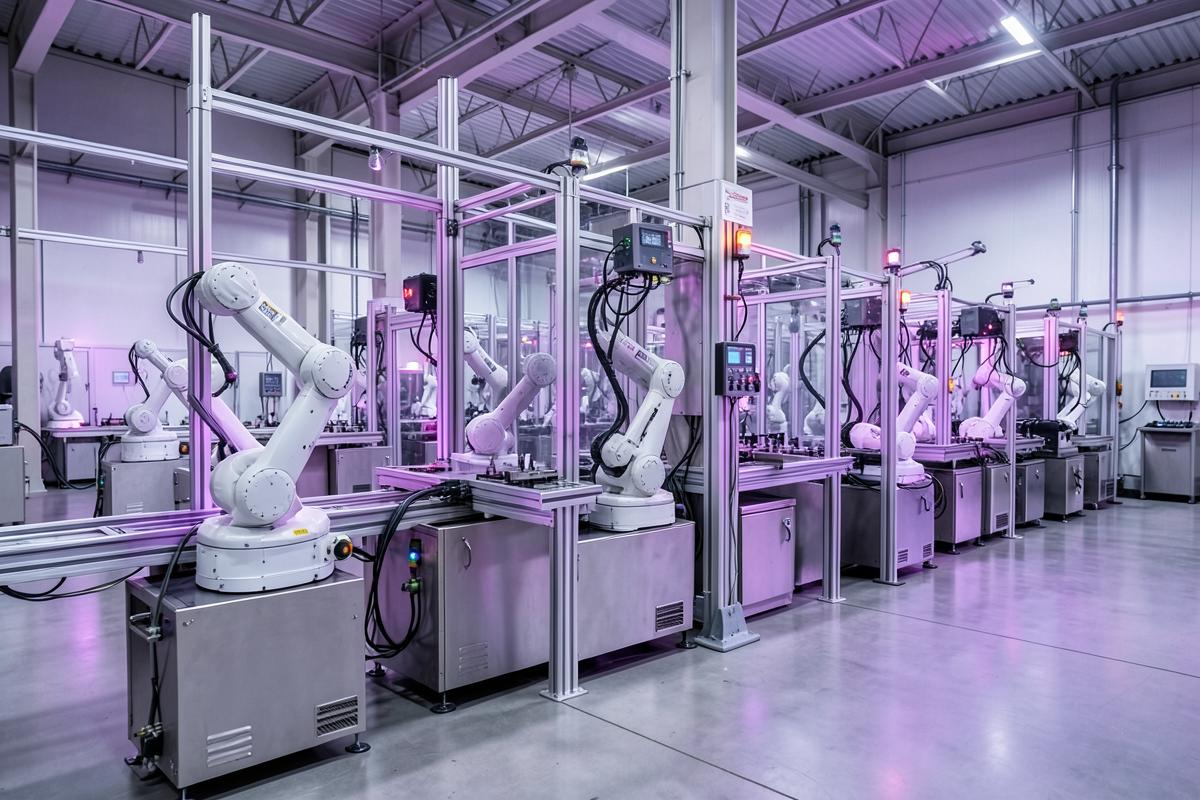
Key Operational Telemetry & Impact
-42%
Unplanned Downtime
Average reduction achieved across deployed production lines
<250ms
Telemetry Latency
Edge-to-screen signal refresh rate via industrial fieldbus
98% Caught
Micro-Stoppages
Short stops under 3 minutes detected and categorized
100% Live
OEE Visibility
Real-time availability, performance, and quality indexing
1. The Cost of Industrial Blind Spots
In high-throughput manufacturing, an unmonitored production line is an expensive liability. According to international manufacturing benchmarking studies, unplanned downtime costs industrial enterprises an average of $260,000 per hour across automotive, discrete parts, and heavy process facilities.
Yet, the most insidious losses rarely come from catastrophic mechanical disasters. Instead, they stem from chronic 'micro-stoppages'—brief 30-second to 2-minute interruptions caused by sensor misalignments, feeder jams, or minor thermal trips. When operators rely on manual paper clipboards or shift-end spreadsheet logging, these micro-events slip past unnoticed while quietly degrading plant availability by 15% to 25% each day.
If an operator only records stops longer than 10 minutes, up to 70% of total lost production hours remain completely invisible to plant management.
2. Live Telemetry vs Shift-End Reporting
Traditional manufacturing plants operate in post-mortem mode: supervisors gather at morning stand-up meetings to examine what went wrong yesterday. By the time a defect rate or motor overheating condition is reviewed, thousands of substandard units have been produced, or a key motor winding has suffered irreversible insulation breakdown.
Real-time industrial monitoring replaces retrospective guessing with millisecond-grade telemetry directly sampled from Programmable Logic Controllers (PLCs), Remote Terminal Units (RTUs), and smart instrumentation. Through industrial protocols such as Modbus TCP, Siemens S7, and OPC-UA, operational states are synthesized into intuitive visual indicators before mechanical limits are exceeded.
- Sub-second status acquisition across disparate machine builders and vintage equipment.
- Automated transition detection between Running, Starved, Blocked, Idle, and Fault states.
- Elimination of subjective operator logbooks through verifiable machine timestamps.
- Immediate alerting to maintenance dispatchers via visual synoptics and local notification workflows.
3. Real-Time OEE Calculations
Overall Equipment Effectiveness (OEE) is the universal benchmark of manufacturing productivity, composed of Availability, Performance, and Quality. However, calculating OEE at the end of the week renders it a purely historical KPI.
RockLyzor recalculates OEE on every cycle. If line speed dips below standard cycle time, the Performance ratio drops immediately, prompting line supervisors to inspect belt tension or raw material feeding before backlog accumulates.
4. Rapid Alarm Rationalization & Escalation
A common hazard in manufacturing operations is 'alarm flooding'—where operators are bombarded with hundreds of low-priority warnings, leading to alarm fatigue. When an actual critical event occurs, it is frequently overlooked.
Modern industrial monitoring adheres to the ISA-18.2 standard. Alarms are classified into hierarchical tiers with deterministic escalation rules: if a high-temperature warning remains unacknowledged for 120 seconds, it automatically escalates to the senior maintenance engineer on shift.
Properly configured alarm boundaries reduce operator cognitive load during emergency conditions by over 80%, directly cutting Mean Time to Repair (MTTR).
5. Operational Payback & Action Steps
Implementing centralized real-time monitoring delivers measurable returns within months. By capturing every cycle, quantifying micro-stoppages, and equipping maintenance teams with immediate diagnostics, plants routinely recover 30 to 90 minutes of productive runtime per machine every day.
Connecting existing PLC registers to a secure on-premise monitoring platform provides the exact operational truth required to optimize continuous output.
ENGINEERING FAQ
Frequently Asked Engineering Questions
Can real-time monitoring connect to older legacy machines?
Yes. By utilizing industrial gateway devices that interface with 24V digital I/O, current clamps, or legacy RS-485 Modbus networks, vintage machines can be integrated alongside modern PLC-driven equipment.
Will real-time monitoring overload the factory OT network?
No. RockLyzor uses lightweight query cycles and event-driven telemetry protocols (such as MQTT Sparkplug B and optimized PLC polling routines) that consume less than 2% of standard industrial network bandwidth.
How quickly can teams expect measurable ROI?
Most industrial facilities identify chronic bottlenecks and recover initial implementation costs within 60 to 90 days after baseline telemetry is established.
CONTINUE EXPLORING
Related Industrial Insights
How Industrial Energy Monitoring Reduces Hidden Losses
Find consumption patterns, demand peaks, and utility penalties that traditional monthly utility invoices never reveal.
SCADA vs Traditional Industrial Monitoring
A practical technical comparison between centralized supervisory intelligence and isolated machine-level operator screens.
Understanding Power Quality in Industrial Facilities
The essential electrical indicators behind reliable equipment health, harmonic mitigation, and electrical switchgear resilience.
Start with your operation
Ready to See Your Factory Differently?
Discover how RockLyzor can centralize your industrial data and give your team real-time operational visibility.